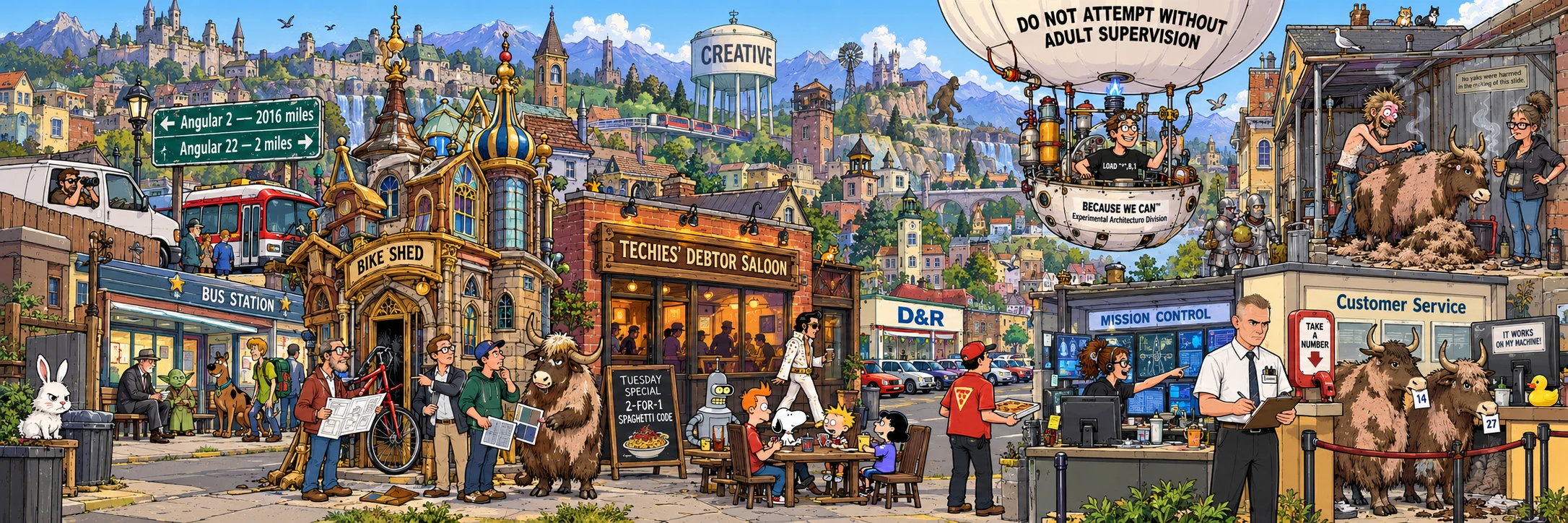
Creative
Creative Director / Designer
Creativity Is Problem Solving
Creativity is not a layer I apply after the serious work is finished.
It is part of how I solve the problem.
Sometimes the solution is visual. Sometimes it is interaction, language, architecture, motion, or an unexpected combination of technologies.
The medium changes.
The objective is to find an answer that is useful, appropriate, and distinctive.
Start With A Concept
Strong creative work begins with an idea, not a style.
Before deciding what something should look like, I want to understand what it should communicate and how it should feel.
That gives the design a reason to exist beyond aesthetics.
Typography, imagery, composition, interaction, and motion can then support the concept rather than becoming the concept.
Constraints Make The Work Better
Creative freedom does not mean working without constraints.
Responsive layouts constrain space. Accessibility affects interaction choices. Performance influences assets and motion. Product requirements determine what must be communicated. Existing architecture establishes technical boundaries.
Those constraints define the problem.
Finding something interesting inside them is part of the work.
Iteration Beats Attachment
The first idea does not receive special protection because it came first.
I explore alternatives, compare them, identify what works, discard what does not, and iterate.
AI has expanded that process by making it practical to explore multiple interpretations of the same creative brief independently and then compare the results.
The technology can generate alternatives quickly.
Creative direction still requires deciding which ideas deserve to survive.
Creativity And Engineering Belong Together
I have spent much of my career working where design and implementation overlap.
That changes how I approach creative problems because I understand the medium in which the idea eventually has to live.
HTML, CSS, animation, responsive behavior, accessibility, performance, components, imagery, and application architecture are not merely implementation details.
They are part of the creative vocabulary.
Understanding how something is built creates opportunities that disappear when design and engineering are treated as unrelated disciplines.
Consistency Does Not Require Sameness
Reusable systems are valuable because they create consistency and reduce unnecessary decisions.
But a system should not erase the identity of the thing being created.
The Perspective pages share architecture while allowing each perspective to communicate differently. The employment-history case studies use common structures while telling very different stories.
The system provides coherence.
The content provides identity.
Brand Is The Accumulation Of Decisions
A brand is more than a logo.
It is the cumulative effect of typography, language, imagery, interaction, spacing, motion, restraint, and hundreds of smaller choices.
The strongest identity emerges when those decisions consistently feel like they belong to the same product without requiring every experience to look identical.
Make Room For Experiments
Not every creative experiment needs to become a permanent feature.
Some ideas need room to be explored before their value is obvious.
djamespoer.com gives me a production environment where I can experiment with visual systems, interaction, motion, generative imagery, branding, and new combinations of design and technology.
Some experiments ship.
Some influence something better.
Some get discarded.
Knowing which is which is part of creative direction.
What This Perspective Demonstrates
My creative work combines concept development, visual thinking, interaction design, technology, experimentation, and production discipline.
I can work within constraints without allowing the constraints to dictate a generic answer.
I care about consistency without demanding sameness, polish without sanding away personality, and experimentation without confusing novelty with value.
Useful should not have to mean forgettable.
Practices
Creative Direction · Visual Design · Concept Development · Interaction Design · Art Direction · Brand Systems · Responsive Design · Motion · Generative AI · AI-Assisted Creative Direction · Iterative Design · Design Systems · Front-End Development · HTML · Sass/SCSS · Angular · Accessibility · Performance · Production Design